Building Digital Access: NTIA Partners with Tennessee on Broadband Summit
by Doug Kinkoph, Associate Administrator, Office of Telecommunications and Information Applications
Nationwide broadband connectivity is the aspirational goal bringing together broadband leaders for the March 20 Tennessee Broadband Summit in Nashville. The event, sponsored jointly by NTIA and the Tennessee Department of Economic & Community Development, is an all-day program with workshops and problem-solving presentations from industry, state and local leaders, and community groups working to build connectivity options throughout the state.
Strong leadership at every level of government can lead to increased broadband deployment. New opportunities through the Tennessee Broadband Accessibility Act and other state and Federal initiatives are vital tools that can help increase broadband accessibility. Also encouraging is the increase in broadband leadership from states, as evidenced in the strong participation at a recent meeting in Washington, D.C. of state broadband leaders across the country to discuss the types of challenges, programs, and investments that are happening at the state level.
Faster Broadband, Reaching More
Access to high-speed Internet has become a necessity for communities and businesses, and the latest data from the National Broadband Map shows that broadband continues to be available to more Americans than ever.
Broadband drives economic growth and innovation – including advances in health care, education, and public safety. Since its launch in 2011, the National Broadband Map has been helping businesses and consumers access broadband by detailing where and what types of high-speed Internet services are available in their communities.
Considering wireline and wireless technologies together, the slowest broadband speeds are nearly ubiquitously available, and access to very fast broadband (over 100 Mbps) has now reached two-thirds of Americans. The data, as of December 31, 2013, shows that 99 percent of Americans have access to wired and/or wireless broadband at advertised speeds of 6 Mbps downstream and 1.5 Mbps up, though this number drops to 89 percent when considering wireline broadband alone.
Blog authors:
Bringing Broadband to Schools in Rural Michigan
President Obama’s ConnectED proposal aims to bring next-generation broadband, with speeds of at least 100 megabits per second and high-speed wireless, to K-12 schools across the nation.
Nowhere is the need greater – or the challenge tougher – than in rural America. High-speed Internet connections can give students living in remote communities access to classes, teachers and instructional materials that those in urban regions may take for granted. But with so many rural areas still lacking advanced telecommunications infrastructure, schools in these places often remain cut off from the promise of broadband.
In Michigan, a non-profit broadband provider called Merit Network is tackling this challenge by connecting K-12 districts in some of the most far-flung reaches of the state.
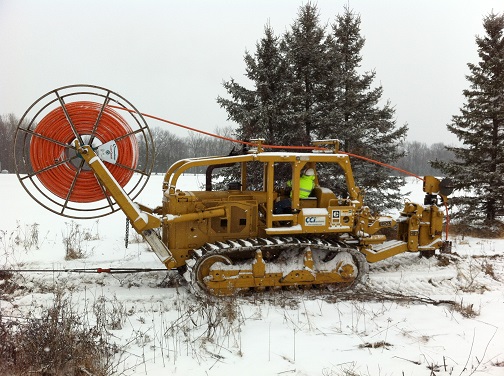
Merit, which owns and operates a statewide research and education network, dates back to the early academic and government networks that evolved into today’s Internet. It was established in 1966 by the University of Michigan, Michigan State University and Wayne State University.
Today, Merit is using more than $100 million in federal funding from NTIA’s Broadband Technology Opportunities Program to install more than 2,000 miles of fiber to expand its network across the rural stretches of the state’s northern Lower Peninsula and the remote, economically distressed Upper Peninsula. Before the NTIA investment, “there wasn’t a whole lot of infrastructure” in the region, says Jason Russell, Merit’s member relations director.
Report from the field: Clearing the way for construction in Maine
Guest post by Joshua Broder, President, Maine Fiber Company, Inc.
Since the Three Ring Binder project received BTOP funding in December 2009, we have been hard at work moving forward to make this project a reality for Maine. One of the first steps we took was working with state legislators and telecom, business, and community stakeholders to pass a state law (as reported in the Bangor Daily News) establishing a new class of utility called a Dark Fiber Provider (DFP). This law will allow the Maine Fiber Company (MFC) to use utility poles to provide leased fiber on an open access, non-discriminatory basis to other telecom carriers and institutional users, thereby meeting BTOP’s open network requirements.
We’ve also recently submitted the Environmental Assessment required for the installation of fiber-optic cable along an estimated 36,000 telephone poles. The assessment included detailed consultations with the US Army Corps of Engineers, US Fish and Wildlife Administration, Maine State Historic Preservation Office, Maine State Planning Office, Native American Tribes, and the National Oceanographic and Atmospheric Administration. By completing this assessment, we’ve cleared the way to begin construction across 1,100 miles of rural Maine.
Meanwhile, community anchor institutions are signing up for service along the BTOP funded route. MFC is in talks with the University of Maine system to connect campuses all over the State with a dark fiber network capable of supporting an ultra-modern 10-gigabit research network that will eventually link University of Maine Campuses with the University of New Hampshire.
Blog authors:
Improving Public Safety Communications
One of the key benefits of expanding broadband services in America is improved public safety communications. Fire, police, and other safety officials must be able to communicate seamlessly and reliably with one another to best prevent and respond to emergencies. New broadband applications can transform emergency response, too. For example, broadband can enable first responders to view the layout of a burning building before entering it or transmit critical video images from an accident scene.
Blog authors:
A True Partnership
This week we received and posted valuable input from States, Territories and Tribal entities about our Round 2 applications. As a result, BTOP staff will have valuable, in-depth perspectives into the local impact of the proposals under consideration. As was the case in round one, we received thoughtful views from State CTOs, technology advisors and other key staff for governors and Tribal Leaders on which projects would best reach their most underserved and economically needy areas.
Many of the local “point people” responsible for this consultation went above and beyond to make sure their office created a robust rubric for analysis of the applications; in one case the comment document is a full-fledged report of the state’s broadband agenda, with sixty-plus pages of scoring charts, letters of intent and recommendation, and details about each recommended applicant.
For our Tribal outreach, NTIA made a true commitment to deliver on President Obama’s recent memorandum to federal agencies, calling for “engaging in regular and meaningful consultation and collaboration with tribal officials in the development of Federal policies that have tribal implications.” NTIA sought the views of Tribal Leaders of Native Nations and spent many hours preparing personalized packages to be delivered to every Tribe in the nation.
Blog authors:
Wrapping up Round One
This week marked the announcement of the final BTOP Round 1 grants. "Last, but not least" certainly describes these awards. Among them are some very meritorious last mile infrastructure projects in Idaho, Kentucky, Oklahoma, Virginia, and Washington. In Puerto Rico, we are funding a project that will enable broadband providers, anchor institutions, and government entities to band together to deploy a wireless middle mile network across the island, enhancing access and reduce costs. In addition, the final Sustainable Broadband Adoption grant of Round 1 is a strong, comprehensive 31-state project to educate, connect, and help close the digital divide in low-income communities across the nation.
Overall, BTOP Round 1 involved 82 grants for $1.2 billion in federal funding. Almost every state in the nation will be impacted by these awards – either in terms of improved broadband capabilities, access to broadband at new or improved public computer centers, or by way of broadband education and training. Beneficiaries include rural areas, urban areas, tribal areas, low-income areas, the public safety community, the educational community, small businesses, minority businesses, and those with disabilities. We look forward to building on this strong foundation in the coming months.
Blog authors:
BTOP wins Commerce Dept. Environmental Stewardship Award
The BTOP Compliance/Environmental Team marked Earth Day yesterday by accepting the 2010 Department of Commerce Environmental Stewardship Award from the Commerce Department’s Director for Administrative Services Mary Pleffner and Deputy Assistant Secretary for Administration John Charles. This annual award recognizes outstanding achievements of Department employees for efforts that significantly contribute to, or will promote, environmental stewardship.
BTOP was selected to win this award for its development of a model program to meet National Environmental Policy Act (NEPA) requirements under severe time and logistical restraints. Though the Recovery Act required NTIA to get BTOP up and running under a compressed timeline, from day one we’ve been dedicated to ensuring that our grants meet all federal compliance standards.
Congratulations to the Compliance team for their commitment to environmental stewardship and earning this award!
Blog authors:
Welcome to our new look!
Welcome to the NTIA blog on our updated broadband programs web site. This site will be the best source of current information about NTIA’s Broadband Technology Opportunities Program and the State Broadband Data & Development Grant Program. Take a look at the projects that have been awarded in your state or territory by exploring the map on the Grants Awarded page.
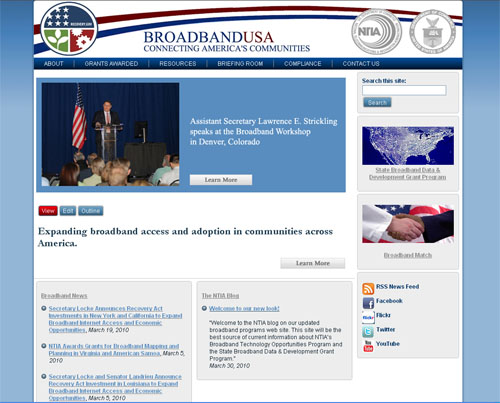
BTOP’s second round application window just closed, and we are no longer accepting new BTOP applications. We’re tallying up all the Comprehensive Community Infrastructure, Public Computer Center, and Sustainable Broadband Adoption applications we received in the past several weeks and will be adding them to the searchable application database shortly, so check back soon.
Blog authors: